
Social networks are an integral part of our lives today. Facebook, Instagram, Snapchat, Twitter, Tiktok and others have become practically essential for a good part of the world's population.
Some data, from the site Visionary Marketing :
- The time people spend daily on social networks has continued to increase in the past five years.
- In 2020, It is estimated that a person passes on average 2 hours per day on social networks.
- From here 2021, more 3 billion people should be on social media, or near40 % world's population planned that year.
That makes people !
Before going further, I would like to clarify an entry point. I am not not anti -social networks (It would be the height coming from a blogger 🙂 ).
I find that these are great tools to stay in touch with our loved ones, who sometimes live very far from us, Information or even learn new things (e.g. Play a musical instrument thanks to YouTube tutorials).
I learned myself (and continue to learn) A lot about bodybuilding via YouTube, Facebook or Instagram.
And then good, Let's be honest… The memes, that's life !

However, Social networks can also have a very harmful impact on us.
A – The effects on our brain
1 – Dopamine et addiction
Dopamine is a neurotransmitter, that is, a chemical substance released by neurons. This molecule plays a key role in our behavior, Because it is she who leads us to carry out the actions that give us pleasure, by acting on the reward circuit of our brain.
She is also called “The hormone of the motivation” Where “of pleasure“.
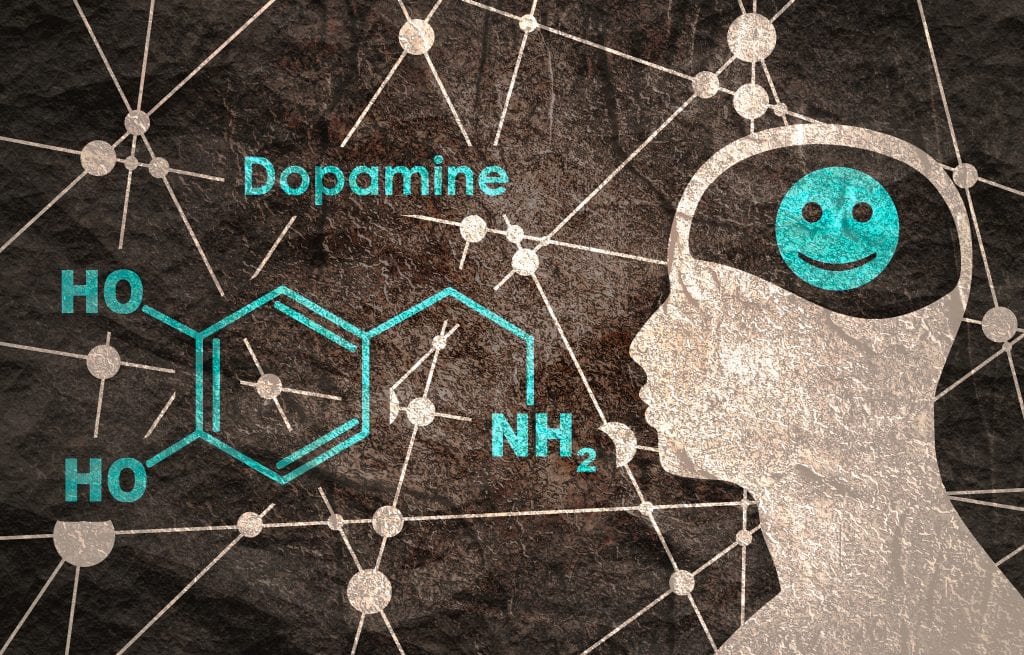
The term “pleasure hormone”, widely used, can however be confusing.
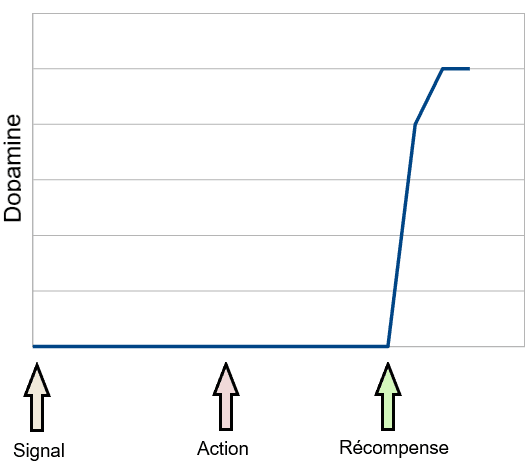
In 1993, An experience conducted at The University of Friborg (Suisse) on monkeys, has highlighted an interesting phenomenon.
The monkeys had to activate a lever (action) Following a light signal (signal). Once this action is carried out, The researchers gave these monkeys with apple juice (reward).
The very first time, There was a secretion of dopamine After have obtained apple juice. We can schematize this phase of the experience by the graph below :
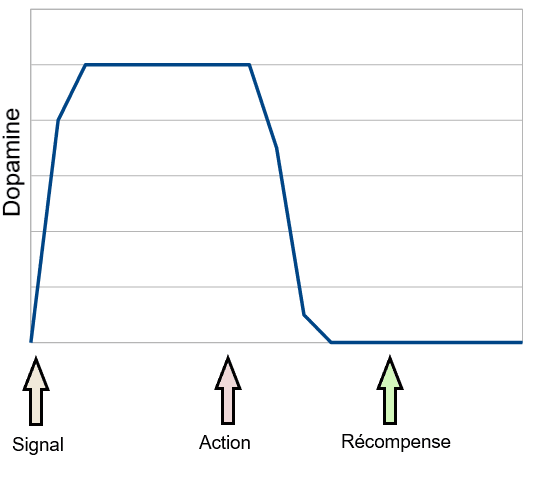
However, As soon as the monkeys were used to receiving the award, Experience has shown that dopamine secretion was done after receiving apple juice, most As soon as the light signal was active.
The experience did not stop there.
Do you think, What happens if the monkeys receive the reward for random, After activating the lever ?
The results are final. Dopamine secretion is much stronger in this case.
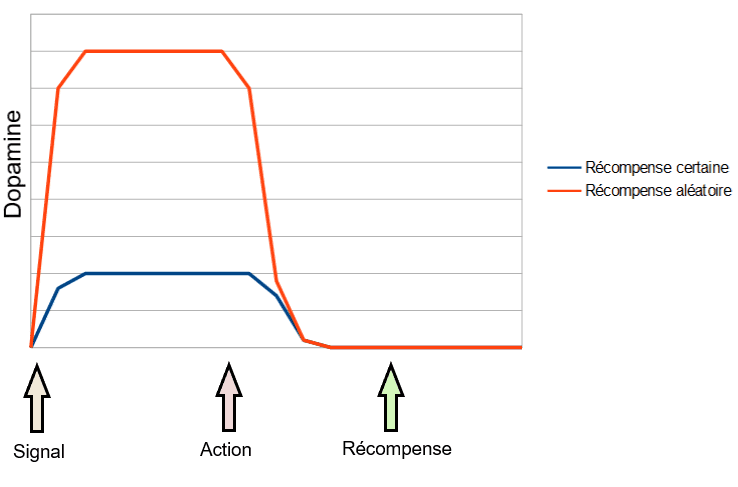
Here is the conclusion of this experience :
In fact, Dopamine is not responsible for the pleasure felt When we perform an action, but rather the desire to perform this action for a potential reward (Typically the case for gambling, which can create a strong addiction).
Dopamine is not related to pleasure, but rather The expectation of pleasure, that's to say The pursuit of happiness rather than happiness in itself.
Robert Sapolsky – Professor of biology and neurology at the University of Stanford (USA)
This principle of “random reward” is very well understood and exploited by the designers of our favorite social networks, And that's why they have so much impact on us.
When you think about it, we do not necessarily find interesting content as soon as we open our applications.
However, If we continue to scroll (scroll), maybe that we are going to come across a very funny photo (The famous memes), An exciting video or super interesting information.
Our experience on social networks is very much like this :
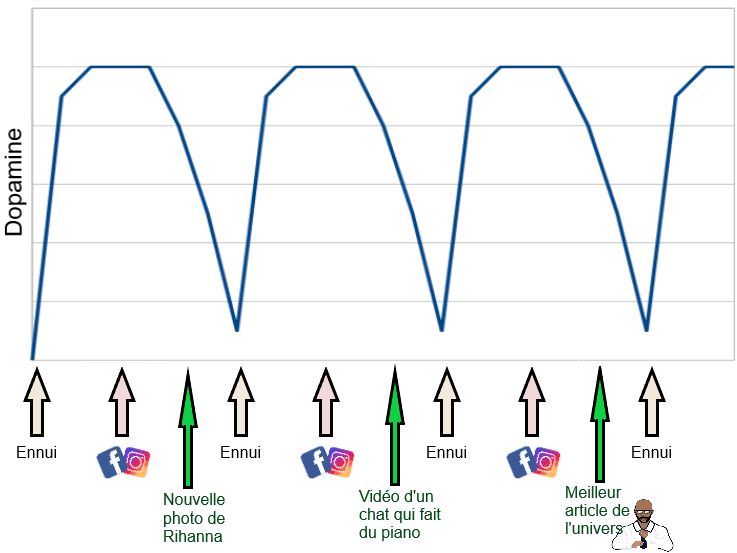
Repeating this cycle again and again consolid this habit, and it becomes extremely complicated to get rid of it.
2 – Social networks sabothed our will
Human beings have always had a insatiable desire new information. At the time hunter, It was essential to discover new sources of water, shelter, hunting grounds etc. to survive. This constant need for new products is therefore anchored deep inside us.
The problem, It is that in our time, It is enough for us to move the thumb to access a flow continu and unlimited new information. So we find ourselves passing 20 minutes to scroll on Instagram, While at the base, We just wanted to watch the time on our smartphone.
And constantly use the social networks of compulsive way ends up “reschedule” our brain : We become much more easy to distract.
And that makes it becomes more and more difficult to do things that we perceive as being less stimulating and which require a certain concentration for a long time : read a novel, learn to play an instrument, write your work report etc.
Ce constant need to be distracted is very harmful in the long run, Because it completely sabots our desire and our ability to engage in actions whose reward will only happen on the long terme.
3 – The risk of mind closing
“Oui, But I use social networks to have different points of view !”.
Good, In fact, I would say it depends on the subjects. I explain myself.
We naturally tend to give more credit to information that values what we already think. This is called the confirmation.
We are ALL subject to this, sans exception. Especially when it comes to subjects that define our deep identity (policy, religion, power mode etc.).
receipt of the request, Human beings are social by nature. We all need primary need to belong to a group. And what could be easier than creating/joining communities on social networks ?
The latter increase the phenomenon of confirmation bias, pour 2 main reasons :
- It is extremely easy to find content there well -built and well -argued that goes in our direction, Whatever the subject in question.
- Algorithms in these applications identify our habits and offer us always the same type of content (the famous suggestions).
The consequence of all this is that plus We spend time on social networks, less We are open to certain subjects, Contrary to what one might think at first glance.
They can just as well we open the mind that we lock up in our convictions.
One of the many social media impacts is that they can make us lose out If we attach more importance to the approval of a “groupe” and/or a number of “Like”, Rather than the truth.
B – Social networks in the world of fitness
As I wrote above, Social networks are for me a great source of knowledge and inspiration, For all that relates to bodybuilding and fitness in general, And I think that many pages or YouTube channels have a rather positive impact overall.
However, There is everything and anything. And in the “anything”, There is something to do.
I have already explained in my article How to motivate yourself to play sports that we should not compare to professional athletes because, Unlike us, Their environment was optimized so that they are as efficient as possible.
But let's talk this time about these fitness models who sell us the H24 dream.
1 – Marketing kings
We see multiplying programs and diets to multiply “lose weight quickly” Where “build muscle in a few weeks”. Marketers have understood that many people want a maximum results with a minimum d’efforts.
And of course, Fitness influencers also understood this. Ils(they) therefore use their very aesthetic physique to highlight “training programs” completely smoky, who promise mountains and wonders, Limit without moving from his sofa.
Others, Even if they offer interesting content, sell many products, the majority of which(e)bodybuilding do not really need.
Most of the muscles know the celebrities of fitness, as Simeon Panda (almost 7 Millions of Instagram subscribers).
Here is one of his most recent publications.

Do you think, What happens in the head of a fan who lacks hindsight or knowledge in bodybuilding, When he comes across a photo of this kind ? “The question was quickly answered 🙂 ” .
There is a good chance that he will take out his credit card without thinking.
The fact that athletes of such a level put these products forward as being the solution to resemble them is purely marketing.
Because some of them, use means a little less… natural.
2 – Doping : A taboo subject
When I talk about doping, These are obviously products like the anabolic steroids and others growth hormones.
As a reminder, It has nothing to do with food supplements.
I will never repeat it enough : Powder proteins do not miracle !
If in your day, You manage to consume via all your meals (eggs, Pisces, meats, legumes etc.) the amount of protein you need, You don't need powdered protein ! For more details, You can refer to this article : protein powder : indispensable ?
Keep in mind that, Unlike food supplements, doping products are generally illegal.
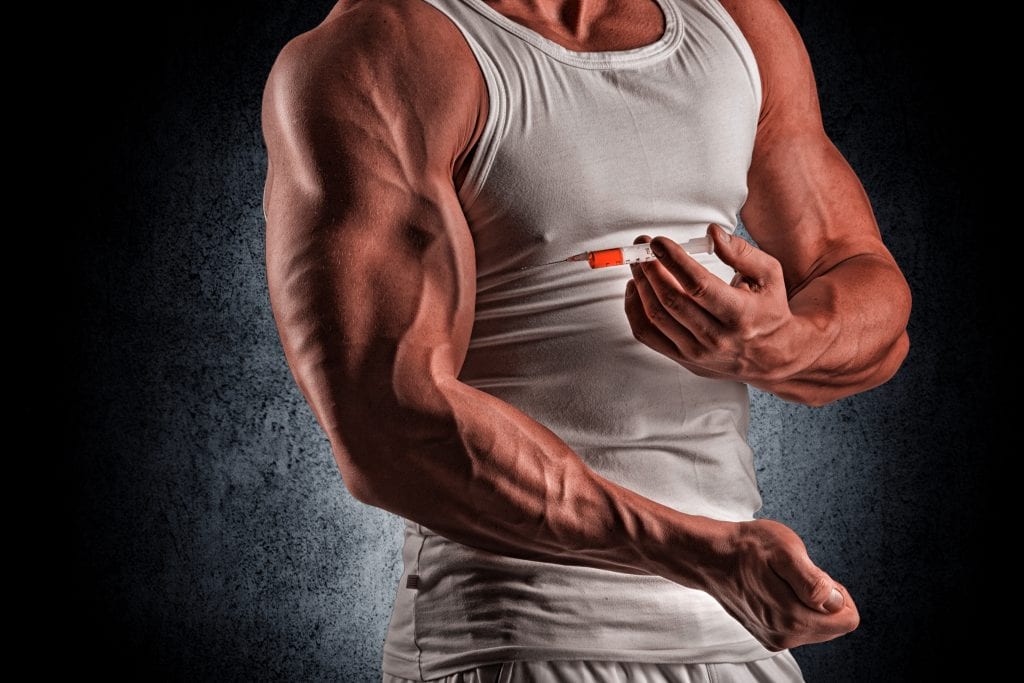
Personally, I have absolutely nothing against people who take doping products. Everyone does what they want, And we are not people to judge.
However, I have a little trouble with those who lie like teeth proclaiming themselves “natural”, Because this can have devastating consequences on the youngest, who take them as models.
Someone as Simeon Panda for example, Even if he claims loudly that he is natural, East most likely doped. Sorry if it's your idol, But it must be said clearly.
As much, When I started bodybuilding, reaching his physique was my goal. I trained until full exhaustion, With loads far too heavy for me. I understood after a while that it was not possible without some “aides”.
Fortunately, I got out of it without major injuries. But this is probably not the case for everyone.
However, I want to specify a few points :
- It is not because a person is doped that All she says is throwing in the trash. These athletes can, despite everything, offer very relevant content (Exercises execution, recipes, mindset etc.).
- Even if a person is “very muscular” compared to Your repository, This does not necessarily mean that she is doped. Many other factors are to be taken into account (training quality, regularity, food, genetics etc.).
3 – Fit girls : The madness of the glutes
You certainly imagine that on the most beautiful Instagram photos, models (men as women) are presented in their best light (congestion, posing, Ideal lighting etc…). In addition to that, Some photos are slightly retouched.
Let's focus on women : There is a real explosion influencers who have built a notoriety by highlighting their glutes.

The impact that this type of photos have in women who spend a lot of time on social networks, is huge.
This is not surprising. Many women aim to display a fine size and very developed glutes. Programs “ABDOS-FESTIERS” So are all the rage in the female gender.
However, there are certain elements to take into account.
- Cosmetic surgery : oui, many fit girls use the surgery aesthetic (Fat injection in the buttocks, prostheses etc.). Of course, The vast majority of them will be careful not to tell you.
- Extremely neat posing: Place to take the best possible photo is limited an art. By playing on angles, you can easily create a optical illusion and giving an impression of buttocks are much larger than they are actually.
Let us hear well. It is quite possible to develop your glutes via bodybuilding.
But know that there are influencers who have used cosmetic surgery, and who allow themselves to sell programs “buttocks” by making you believe that you can look like them one day. It is the scam pure et simple.
Especially since very often, These programs are created by other sports coaches, and they don't even follow them themselves.
However, There are some who are rather honest and who provide quality advice, But who have an advantageous morphology/anatomy/genetics compared to other women (e.g. Very pronounced camber, naturally prominent buttocks etc.).
Even if their program is well done, An average woman will probably not have the same results by following it, Even if there will probably be progress after a few months.
And don't forget that it does not exist final exercise. Some people will take everything in the thighs By making the squat. And others in The buttocks. So listen to your body and your sensations, and do not blindly follow the program of a Fit Girl “Because she's too good”.
Moreover, any promise of the type “Double her buttocks in 2 weeks !” is a bullshit. Point.
C – Conclusion
Far from me the idea of saying that you should never go on social networks again. Whatever you say, They have some use and I use them regularly.
However, They can prove to be problematic in many ways.
Most applications are designed to spend as much time as possible. You can easily become Smartphone addict, by scrutinizing it all 5 minutes on the lookout for the slightest novelty. And in the long term, This can ruin our concentration capacity, and therefore our productivity.
For everything that relates specifically to fitness, be cautious.
Previously, We took as a reference the most made person in his gym or his close entourage. Today, internet, We are in permanent competition with “fit boys” and the “fit girls” What is a cookie " the whole earth.
At best, Influencers and influencers can sell us certain completely ineffective products or programs. But it can go further than that.
It is not uncommon for people, After buying all the products from their idol, followed their program to the letter and not having obtained the expected results question and say to themselves “It’s not for me” (which leads to l’abandon) Where “I don't train hard enough” (which can lead to injuries more or less serious).
While the basic problem does not clearly come from them.
I therefore invite you to make discernment and at Do not put anyone on a pedestal.
So use social networks in a way conscious, To prevent them from using you. And always keep a critical distance from the content offered to you.
Thank you for reading this article !
See you soon on the blog !
Books to find out more :
Nir Eyal – Hooked : How to create a product or service that anchors habits
Nicholas Carr – He makes it stupid ?