
When it comes to building your pectoral muscles without equipment, push-ups are the first exercise that comes to mind.
There are many variations depending on the muscle group you want to target as a priority. (shoulders, triceps etc.). In this article however, I will focus on those who will mainly request the pectorals.
The pumps, like all polyarticular bodybuilding exercises of the type “Push”(thrust), will also use the shoulders and triceps, to varying degrees.

Now let's get to the heart of the matter : what is the correct way to do push-ups ?
The pumps : the right technique
Many practitioners(e)s are not taking full advantage of this exercise, mainly due to technical errors.
In the video below you will find a summary of the main mistakes to avoid when doing push-ups (version standard), with detailed explanations just after.
Mistake #1: Spread your elbows too far away from your body (during the descent) !
This is an extremely common error and can be dangerous, because doing your push-ups this way puts your shoulders in a very uncomfortable position. receipt of the request, there is almost no no tension on the pectorals, and you therefore lose the main benefit of this exercise.
This usually happens when one's hands are too far apart from each other and / or when trying to compensate for a lack of strength in the triceps.
So be sure to always keep your elbows in the same axis as your hands., as shown in the video, except in special cases which we will see later (e.g. push-ups with hands close together).
If you feel your shoulders more than your chest when doing push-ups, there is a good chance that it is because of a poor technique of execution.
Error n°2 : Cambrer the two (lack of sheathing) !
Do not forget to stay covered(e) throughout the exercise. Contract your abs as well as your gluteal muscles, in order to keep your back straight despite the effect of gravity.
If you have difficulty keeping your back straight, already practice staying in the initial position (on a board) to strengthen your abdominal area.
Mistake #3 : Do half repetitions !
A great classic 🙂 .
“How many push-ups can you do? ?” is the equivalent of the question “How much do you lift on the bench press? ?”. In the same way that many people degrade their technique to be able to lift a heavy bar by any means necessary, Many people make the mistake of only focusing on how many push-ups they can do..
However, the amount must never take precedence over the quality ! Manage your ego !
Oui, erase these 3 mistakes will instantly make the exercise more difficult. But this is also what will make it more efficient.
Let's see now 6 different types of pumps, listed in order of increasing difficulty.
6 different types of push-ups to strengthen your pectorals
Knee push-ups (Knee Push-Ups)
If normal push-ups are still too hard for you, do them on your knees. It’s a good basis for understanding movement.. You will be able to strengthen your joints (wrists, elbows) and gently gain strength, before moving on to normal push-ups.
The technical tips explained at the beginning of this article also apply to knee push-ups.
Standard pumps (Push-Ups)
Not much to add compared to the technical explanations in the first chapter.
Trick : You can use parallel bars to increase the difficulty of the exercise. Raising the hands will increase the range of movement and therefore accentuate the stretching of the pectorals.. This is what we call deficit pumps.
Do not spread your hands too far apart as you risk hurting your shoulders..
This deficit can also be created with books for example. The small advantage of parallel bars, is that they are more comfortable for the wrists and therefore very useful if your wrists are fragile.
Push-ups with hands close together (Narrow grip Push-Ups)
The closer your hands are, the more you accentuate the work of the triceps.
You can include this version of push-ups in your program, but the distance between your hands should just be slightly lower to the one between your shoulders.
Here we are looking to strengthen the pectorals as a priority., so there is no real point in doing push-ups “diamond” (with hands together), which mainly target the triceps.
Elevated push-ups (Elevated Push-Ups)
This type of push-up will strengthen the upper part (clavicular) pectorals. They are clearly more difficult than normal push-ups, because in this position, you have more of your body weight to manage with your arms.
Be sure to always stay strong and not arch your back during the movement..
It is also possible to create a deficit with this type of pumps, as for the standard version. However, be careful not to skip the steps.
Archer pumps (Archer Push-Ups)
The principle is quite simple. The goal is to increase the workload by shifting the weight of the body to one side. The greater the gap between your hands, the more weight you will have to lift on the side of your active arm.
Gauge the starting distance carefully to find the right intensity. Being able to do between 6 and 10 repetitions consecutive with each arm is a good goal.
This is a great way to challenge yourself if doing normal push-ups is too easy for you..
And you will probably have to go through this if you want to move on to the next level. : one-handed push-ups.
One-handed push-ups (One arm Push-Ups)
Who has never dreamed of doing one-handed push-ups while watching old-fashioned kung-fu movies 🙂 ? Beyond the fact that they are impressive to see, these pumps are very taxing on the body, if only for the enormous effort that is required to maintain your core.
Your legs should be spread apart so as to form a tripod with your active arm. Otherwise, it will be difficult for you to maintain your balance with one hand.
A good way to practice one-handed push-ups is to regularly do arch push-ups and move your hands further and further apart as seen in the previous video..
The pumps : as effective as the bench press ?
Many practitioners(e)s wonder if doing push-ups is as effective as doing bench presses to strengthen your pectorals. For more details on this exercise, I refer you to This article.

Before you ask yourself this question, answer this one first :
How many push-ups consecutive you are able to perform with impeccable technique ?
Remember that to build muscle, you have to subject them to a certain tension, by performing the exercises with a sufficiently heavy load. And this, whatever the nature of the load (body weight, barre, dumbbells, plane, meteorite etc.)
If you can only do a few push-ups, the bench press question is off topic, because you already have plenty to do, in terms of load, with your own weight.

When we can chain around twenty of push-ups without much difficulty, it is legitimate to ask the question. And the answer is “oui” in most cases (except very advanced athlete), provided that it is managed effectively the intensity of his training.
How to apply progressive overload to push-ups ?
One of the keys to progress in bodybuilding is surcharge progressive (gradually increase the difficulty of the exercises). The most intuitive way to do this is to increase the workload. In the gym, just add kilos to the bar or machine.
It's a little more complicated with bodyweight exercises, such as pumps. You can put on a weighted vest but you won't be able to infinitely increase its weight. If you are very experienced(e), You will likely need to use variations such as archer or one-handed push-ups, which are technically quite difficult to master.
However, there are other ways to achieve progressive overload. For example, you can increase time under tension during exercises (do each repetition more slowly) or decrease recovery time between series.
that being said, let's now see some concrete examples of training programs depending on your level.
Examples of training programs
The programs below are intended to give you a “cadre” and a direction to follow. They are not necessarily to be applied to the comma. You can modify them by adapting the number of sessions, repetitions or series depending on your feelings and your progress.
I will often use the term “Max reps” Where “Max reps”. Ici, This is the maximum number of repetitions you can perform without degrading your technique. We speak then postural failure Where technical failure. It's different from muscular failure, where you're at the end of your life and can't do one more rep, despite all the will in the world.
Level 1

You can't do normal push-ups yet.
In this case, the program should be quite simple. Your primary goal is to gain strength.
Example program :
2 sessions per week ► 4 at 5 series – Knee push-ups – Max reps.
Recovery time between sets : 2 at 3 minutes.
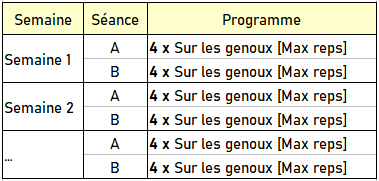
Theoretically, your “Max reps” should gradually increase, week after week. Once you can do 15 knee push-ups, you should be able to do a few normal push-ups.
Level 2
You can do a few normal push-ups (let's say between 3 and 6).
To maintain a good volume of work, don't just do sets of 3 pumps. You can aim for technical failure by including knee push-ups.
Example program :
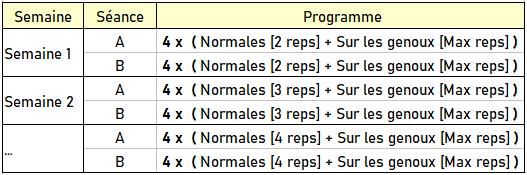
2 sessions per week ► 4 at 5 series – ( X Normal push-ups + Max push-ups on the knees ).
Recovery time between sets : 2 at 3 minutes.
X is a number between 2 and 6. You can increase it from week to week or every 2 weeks for example, to continue to progress.
Level 3
You manage to do between 10 and 20 normal push-ups.
At this stage, you can start to include variations like deficit or feet-elevated push-ups. Start with the hardest variation.
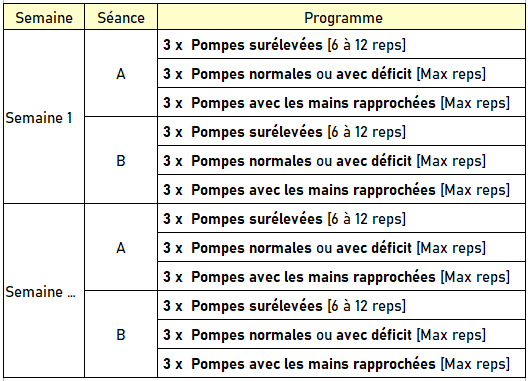
Example program : 2 sessions per week :
– 3 at 4 series – Raised push-ups – 6 at 12 repetitions.
– 5 minutes of rest.
– 3 at 4 series – Normal or deficit pumps – Max reps.
– 5 minutes of rest.
– 3 at 4 series – Push-ups with hands close together – Max reps.
Recovery time between sets of the same exercise : 2 at 3 minutes.
Level 4
You manage to do more 20 consecutive normal push-ups.
It's time to seriously spice up your workouts if you want to continue building your pecs, including archer push-ups, even one-handed if you can do them.
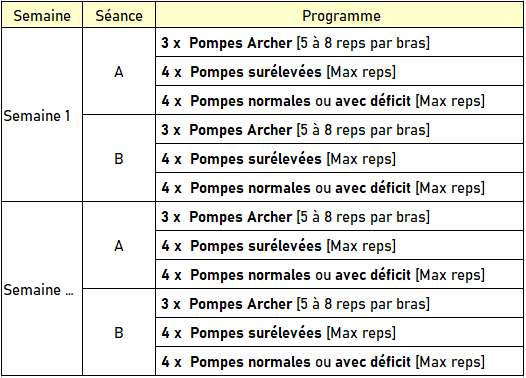
Example program : 2 sessions per week :
– 3 at 4 series – Archer Pumps – 5 at 8 repetitions per arm.
– 5 minutes of rest.
– 4 at 5 series – Raised push-ups – Max reps.
– 5 minutes of rest.
– 4 at 5 series – Normal or deficit pumps – Max reps.
Conclusion
It is entirely possible to strengthen your pectorals effectively with push-ups..
However, many(ses) practicing(e)s pay more attention to the number of repetitions than to the technique of execution. Many, for example, do push-ups only as part of “circuit-trainings”, where we chain several exercises in a row. It is therefore very tempting to do it quickly to move on to the next exercise.
It is, however, a big mistake if you want to fully benefit from all the benefits of this exercise.

You want to improve your push-ups and optimally strengthen your pectorals ? Train with a precise plan and an good technique, and don't just waste energy.
“To exercise” and “practice” are 2 different things. The number of repetitions is not an end in itself.
If you have a good level and can do dozens of push-ups without worry, take it to the next level, with more difficult variations. There are dozens of variations (e.g. jump push-ups) not cited in this article. If necessary, I invite you to do your research to find out more.
I hope this article has been useful to you. Feel free to share it if so. !
See you soon on the blog !