
Mass gain (“Bulking” in English) in bodybuilding is the phase during which we built of muscle.
In this article, we will see how to achieve effective mass gain.
Note: This article is for practitioners beginners (less than a year of bodybuilding) and intermediaries (less of 5 consecutive years of serious training).
calorie maintenance
Calorie maintenance is the total number of calories one should consume daily to keep the same weight.
Suppose your calorie maintenance is at 2500 calories per day. If you consume daily :
- 2500 kcal, your weight will stay stable.
- The personal data collected from users is intended to provide What is a cookie " 2500 kcal, you will be in calorie surplus : you will gradually take weight.
- Less What is a cookie " 2500 kcal, you will be in calorie deficit : you will gradually to lose weight.
So remember this :
- Calorie surplus = weight gain.
- Calorie surplus + Strength training = muscle mass gain.
- Calorie deficit = weight loss.
- Calorie deficit + Strength Training = Fat Loss (or dry).
Define your calorie maintenance
Before launching, it is strongly advised to define your caloric maintenance, in order to determine with precision the strategy to be adopted.
Caloric maintenance depends on several factors (age, sex, physical activity etc.…). Let's take the case of 2 men who have the same physical characteristics (cut, weight etc.…). If one is mason, and the other is clerk, their daily energy needs will be very different.
In effect, the mason will burn many more calories during his working day. He will therefore need to eat daily much more than the office worker, to maintain weight.
The most intuitive way to define your caloric maintenance is to observe how your weight changes according to your diet. :
- Do you eat at a fixed time and in the same proportions every day? ? If the answer is no, structure your diet, for at least 2 weeks before moving on to the next point.
- How your weight has changed over the last month ?
Your diet can be structured as below :
- Breakfast.
- In-cas of 10h.
- Breakfast.
- 4 p.m. snack.
- Having dinner.
It will also depend on your constraints. (if you work at night for example).
Pendant 1 month, try to consume roughly the same foods in the same quantities, while keeping the same way of life. Adjust the quantities according to the evolution of your weight, in order to find a balance.
After 1 month, you should have an idea of the eating plan that allows you to maintain weight stable. Once this step is completed, define how many extra calories (per day) you need.
How many more calories per day ?
It is generally recommended to consume between 100 and 600 kcal more per day. Your choice should be based on 2 main factors :
1 – Your body fat percentage (body fat)
Do you have a lot of belly ? Are your abs very visible ?
The less fat you have, the more you can increase calorie intake and the duration of your mass gain. Conversely, if you have a little fat, limit the calorie surplus as well as the duration.
Above a certain fat level, weight gain is not recommended.
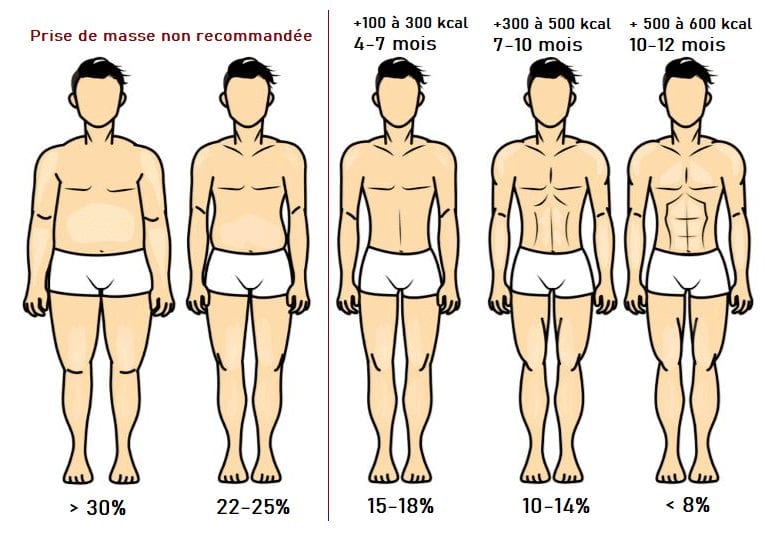
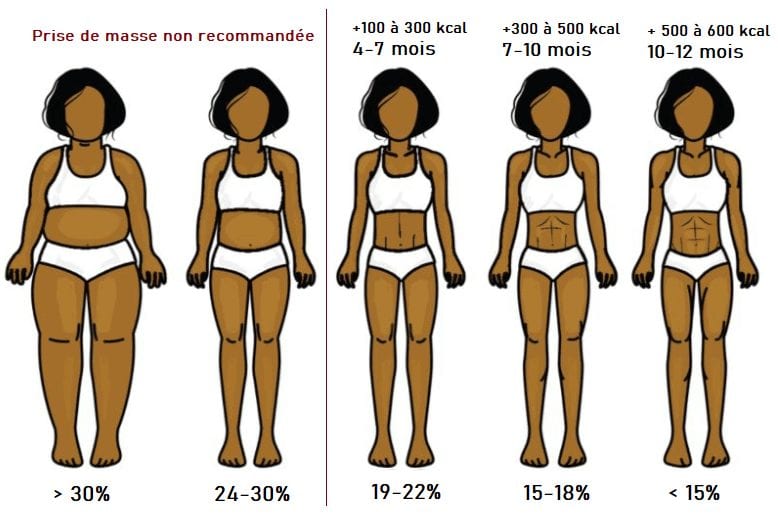
Below are images to help you find your way. It is indicated there daily calorie surplus to aim, as well as ideal duration of a mass gain, based on your current fat level. The body fat percentages are added under each image for reference only.
Men
Women
2 – Your metabolism
We are not all equal when it comes to gaining or losing weight. Some grow fat by inhaling the smell of a donut, others can hit the packet of 10 without taking 1 gramme. It's like that and there's nothing we can do about it.
The personal data collected from users is intended to provide vitesse at which you gain weight should also condition your choice. Ideally, You must take (on average) in between 0,3 kg and 1 kg per month. After 2 Where 3 month, you can adjust your daily calorie surplus by roughly 100 Where 200 kcal, depending on your development.
- As a beginner, you can expect to take in between 7 kg and 12 kg over a year.
- As an intermediate practitioner, you can rely on 4 kg to 7 kg per year.
Note that these extra pounds represent muscle gain ET fat.
It is impossible to take uniquely of muscle. A successful weight gain consists of taking a the greatest of the muscles and a minimum of fat.
How to Manage Added Calories
Once you have structured your diet, it is easy to manage your calorie intake.
- Check the nutrition labels of your usual foods to make the connection between number of calories and quantity.
- Define the meals during which you want to add these calories.
- Spread the calorie surplus over one or more meals.
Suppose you need 300 additional kcal per day. Below is a way to do it :
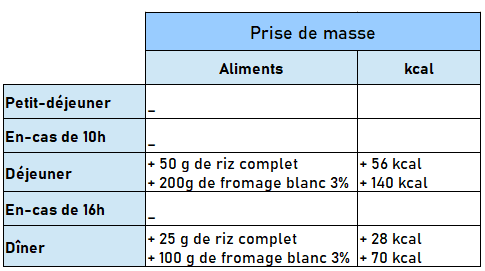
As you see it, it counts fast ! No need to be heavy handed.
Unreasonably increasing your calorie intake will expose you to a high fat gain.
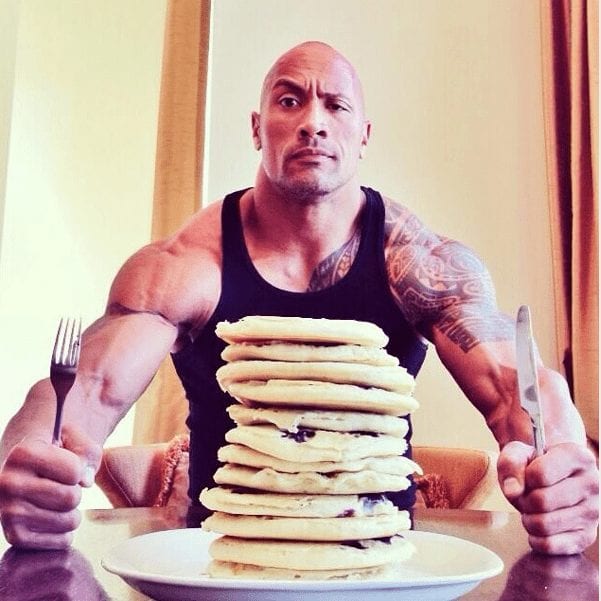
For the curious, American actor Dwane Johnson talks about his diet in this video.
Remember the importance of proteins ! Be sure to consume between 1.5g and 2g of protein per kg of body weight, per day.
Mistakes to avoid when gaining weight
Consider all calories to be equal
Are fast foods high in calories? ? Absolutely.
Is it a good idea to consume a lot of fast food on the pretext that we are gaining mass? ? Not really.
Choose foods that have a low glycemic index (rice basmati, complete rice, lentils, pain complet, vegetables etc.…). This will promote the storage of carbohydrates in the form of glycogen (which the muscles will use as fuel for training), rather than fat.
Do a mass gain “for life”
One of the problems we encounter, when mass gaining (especially when you were very thin at the start) is that we become “addict”. We're so used to this new feeling of filling up our T-shirts, that it is difficult to mentally accept losing weight (even in the context of a dry).
The problem is that the longer the mass gain, the greater the risk of taking gras.
Maintain diet “weight gain” without the proper training
If you don't train for several weeks, slightly reduce your caloric surplus. Otherwise your body stockera simply the excess as fat.
Be sure to keep a regular and intensive training.
Conclusion
For a successful weight gain, key points to remember :
- Train regularly and intensively.
- Keep a structured and regular diet (meal times, quantities etc.…).
- consume between 200 and 600 more kcal each day (lots of protein).
- Adapt the caloric surplus along the way if necessary.
- Be patient !
To lose the fat you will have “won”, you will have to go through the step of Degreasing.
I explain how to make a dryer, step by step in This article.
See you soon on the blog !
[pum_scroll_trigger popup=”990″]
Thanks very much.
And if I understand correctly, those who are overweight do not need to be overweight.
Exact.
The fatter we are, the easier it is to gain fat (it's exponential).
So weight gain should be limited..
It is better to practice, while eating a little less than usual. This will make you lose fat mass gradually.